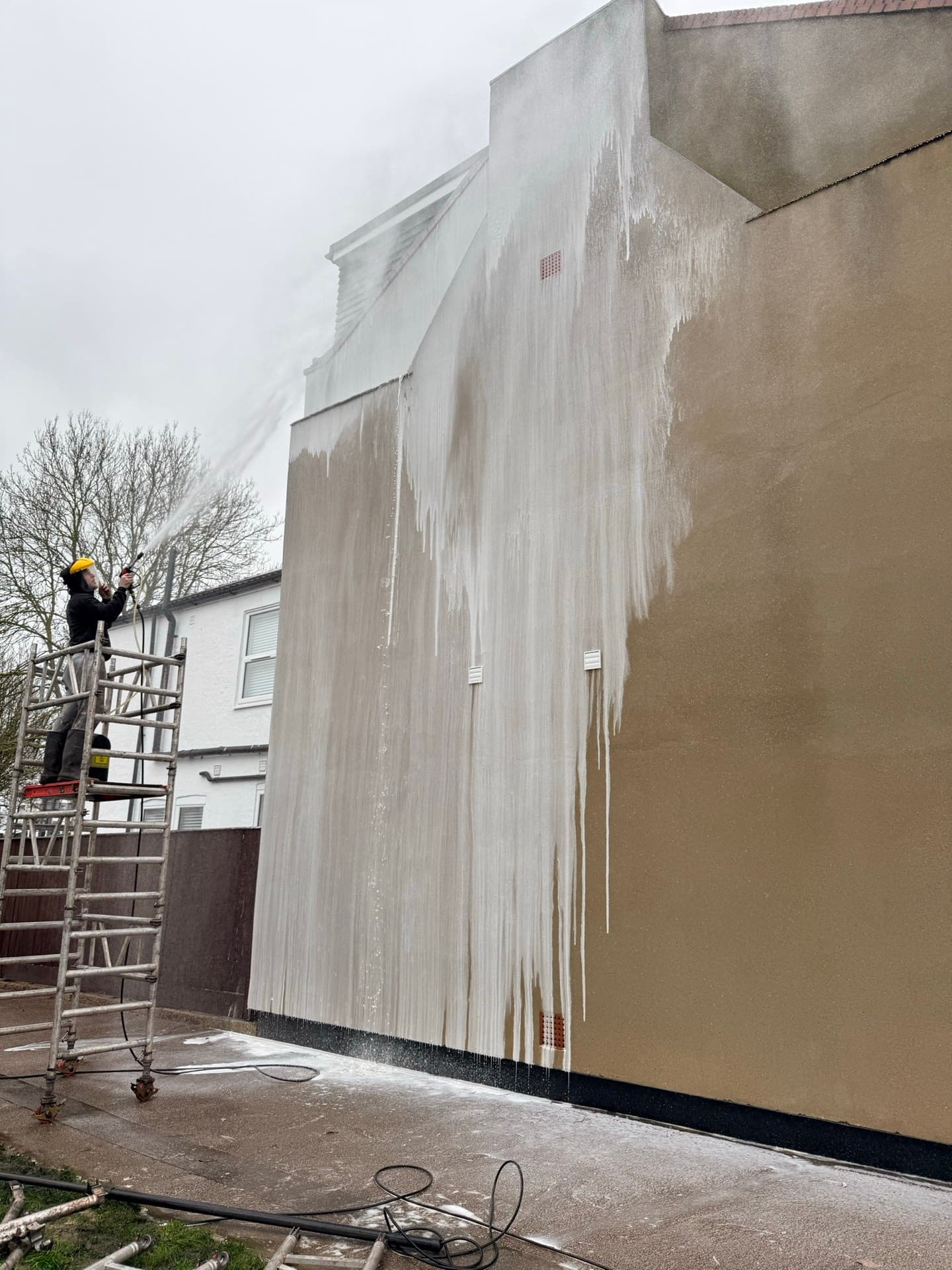
Render Cleaning in Essex: K-Rend, Monocouche and Pebbledash — What You Need to Know
Rendered walls need specialist cleaning. K-Rend, monocouche and pebbledash all require different approaches. Get it wrong and you risk permanent damage.
5.0 Google Rating
Rated 5.0 across all Google reviews
Google Guaranteed
Verified, insured, backed by Google
Smart Seal Approved
Certified installer
No Deposit — Ever
100% satisfaction guaranteed
10+ Years Experience
200+ Essex properties cleaned
Fully Insured
Public liability cover
Rendered walls are common in Essex. Some are modern K-Rend, others are older pebbledash or monocouche. The problem is that all three materials look similar but behave completely differently when pressure washed. Apply the wrong approach and you can damage the render permanently. Here's what you need to know.
K-Rend: acrylic render that hates high pressure
K-Rend is an acrylic-based render that's been popular in the UK since the 1990s. It's attractive, colourful, and relatively durable — but it has one critical weakness: high pressure washing will blow it off.
K-Rend bonds to the substrate, but not as aggressively as traditional cement-based renders. If you blast it with high pressure, the water gets behind the render and forces it off the wall in patches. You'll end up with a surface that's supposed to last 20 years but now needs replacing after careless cleaning.
K-Rend is sensitive to the cleaning chemicals you use as well. Some acidic cleaners can chemically soften the acrylic, making it more vulnerable to pressure or weathering. You need alkaline or neutral cleaning agents, not acidic ones.
Monocouche: similar problem, slightly more robust
Monocouche is similar to K-Rend — it's a one-coat acrylic render. It's slightly more robust than K-Rend in some formulations, but the same pressure-sensitivity applies. High pressure damages monocouche in the same way it damages K-Rend.
The chemical sensitivity is also the same: avoid acidic cleaners.
Pebbledash: older, more porous, more damage-prone
Pebbledash is an older render style (mostly pre-2000). It consists of small pebbles embedded in a cement-based render coat. It looks textured and rustic.
Pebbledash is more porous than modern acrylic renders. Water soaks in easily. High pressure washing forces that water deep into the substrate, behind the render, where it can cause damage. You also risk dislodging pebbles or creating a patchy, damaged appearance.
Pebbledash is more chemically robust (you can use acidic cleaners on it, though we generally prefer neutral), but pressure remains the enemy.
Painted render: the trickiest case
Some renders are painted over. This adds complexity because:
- The wrong chemical can strip or peel the paint
- High pressure will definitely peel the paint
- You need to know what's underneath the paint (K-Rend, pebbledash?) to know what chemicals are safe
We always ask about paint type before cleaning painted render. If it's an old acrylic or masonry paint, aggressive cleaning might peel it. A test patch is essential.
Why Essex's climate is bad for render
Essex is damp. Our prevailing winds come from the south-west, which means north-facing render gets persistently damp. Damp creates the perfect environment for algae and moss. We see three times more algae growth on north-facing render than south-facing.
That persistent damp also means water is constantly trying to penetrate the render. High pressure cleaning exacerbates this — you push water into the pores where it sits and causes damage (freeze/thaw cycles in winter, internal dampness).
The correct render cleaning approach
Render cleaning requires:
- Render type identification: Know what you're dealing with — K-Rend, monocouche, or pebbledash make a difference.
- Appropriate biocide pre-treatment: Use sodium hypochlorite for acrylic renders (K-Rend, monocouche), which kills algae and moss without damaging the render. For pebbledash, you have more flexibility.
- Low pressure application: Maximum 600 PSI for acrylic renders. For pebbledash, maybe 800–1000 PSI maximum. Never higher.
- Time for the chemical to work: Don't rely on pressure. Let the biocide sit and do the work. Algae and moss will naturally die and loosen.
- Gentle rinse: Once the biocide has worked, a gentle low-pressure rinse removes the dead growth.
- Test patch first: Always test on a small, inconspicuous area before doing the whole wall. This shows how the specific render will respond.
What happens if you get it wrong
High pressure render washing can cause:
- Render delamination (it starts peeling off the wall)
- Water ingress behind the render (leading to damp inside)
- Loss of pebbles on pebbledash (creates a patchy, ugly appearance)
- Paint peeling on painted render
- Structural damage if water gets behind the render and into the substrate
Fixing delaminated render means reapplying the whole wall — £30–50 per square metre. A 100 m² house is £3,000–5,000 to fix. This is a very expensive mistake to make in pursuit of a clean wall.
How often should you clean render?
In Essex, north-facing render should be cleaned every 18–24 months. South-facing can go 3 years. After cleaning with biocide, the algae-preventing residue lasts 12–18 months, so timing another clean when you see early regrowth makes sense.
Ongoing maintenance
If your render is in a particularly damp location (sheltered from sun, under tree cover), a biocide maintenance application every 12 months keeps it clean without needing a full pressure wash. This is cheaper and gentler on the render than regular cleaning.
Render is fragile — treat it carefully
K-Rend, monocouche, and pebbledash all need specialist, gentle cleaning. High pressure washing saves money short-term but costs thousands in repairs. Professional biocide treatment is the right method.
Written by Terry
Owner, London & City Pressure Washing · Essex
Terry has cleaned driveways, roofs, patios and gutters across Essex for years. Every job done personally — no subcontractors, no shortcuts. Google Guaranteed and fully insured.
What Essex customers say
“Excellent service from start to finish! London & City Pressure Washing did a fantastic job cleaning the moss off my roof. The team was punctual, professional, and incredibly thorough. They explained the process clearly, worked efficiently, and left everything spotless. My roof looks completely renewed, and the whole property feels fresher. Highly recommend them to anyone needing reliable and high-quality pressure washing services!”
Want results like these for your property?
No deposit. No obligation. Free quote — usually within 24 hours.
Learn more about our Render & Brick Cleaning service →